
Killeen Elite Concrete does decorative concrete in Killeen, TX and the surrounding cities including Fort Hood, Harker Heights, Nolanville, Copperas Cove and Belton, covering everything from a colored broom finish to a stained and sawcut terrace. Decorative work is where concrete stops being a utility surface and starts being a finish you chose, and the range of what is possible is far wider than most people realize before they look at it.
The term covers several quite different things. Some are decisions made in the mix before the truck leaves the plant, some happen in the twenty minutes while the slab is still plastic, and some are applied to concrete that has been down for fifteen years. Knowing which category an option falls into matters, because it determines whether it is available on your project at all.
What does not change is the slab underneath. Expansive clay with a plasticity index in the high thirties over limestone anywhere from nine to thirty inches down means base preparation, reinforcement and joint spacing decide how the work ages. A beautiful finish on a badly built slab simply produces a beautiful surface with a crack across it.
Color, and the Three Ways It Is Applied
Integral Color in the Mix
Integral color is pigment batched into the concrete so it runs through the full section. Its advantage is permanence: a chipped edge or a saw cut shows the same color as the surface, and there is no coating to wear off. On its own it gives a uniform, slightly flat tone, which is why it usually works as a base for something applied on top rather than as the whole finish.
Dry Shake Color Hardener
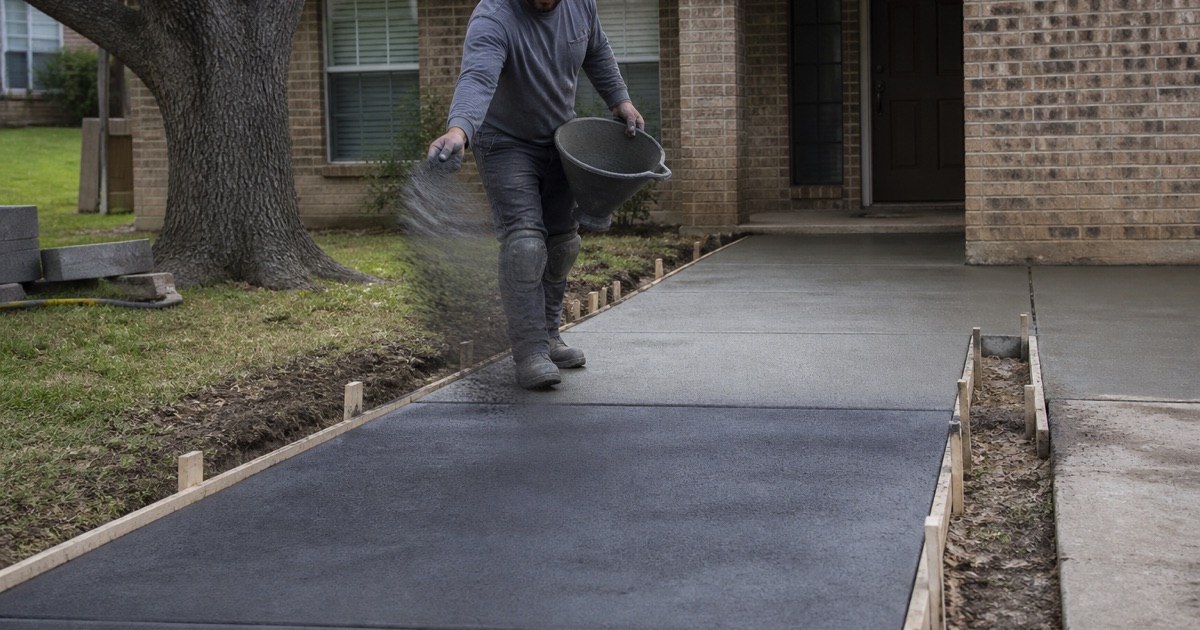
A dry shake color hardener is broadcast onto the surface while the concrete is still plastic and worked in with a float. It does two things at once: it delivers strong surface color, and it densifies the top layer so it wears considerably better than plain concrete. It is the layer that gives a decorative slab both its depth of color and its durability underfoot.
Antiquing Release and Secondary Color
Antiquing release goes down before the stamping mats and lodges in the low points of the texture, leaving a secondary tone in the recesses once it is washed off. That variation is what makes a stone pattern read as stone rather than as a molded slab. Used with an integral base and a hardener, it produces the three-layer color most people picture when they picture decorative concrete.
Texture and Pattern
Stamped Patterns
Mats pressed into plastic concrete transfer a pattern and a texture at the same time. Ashlar slate is the most versatile against the brick elevations common here, cobble and running bond suit paths and courtyards, tile patterns suit covered outdoor rooms, and wood plank gives a deck look without the maintenance. Scale relative to the area matters more than the pattern name.
Seamless Texture Skins
A seamless texture skin lays a stone, slate or leathered surface across the slab with no repeating grid at all. It is what most people around here choose once they have seen both, because it handles a large irregular footprint far better than a repeating pattern and never presents an obviously misaligned joint. Paired with a sawcut border it reads like a tiled terrace.
Exposed Aggregate and Traditional Finishes
An exposed aggregate finish washes back the surface paste to reveal the stone in the mix, giving real texture and excellent grip. A rock salt finish gives a fine pitted surface long favored around pools. Even a well-executed broom finish with integral color and a sawcut pattern is a decorative treatment, and on a driveway it is often the most sensible one.
Decorative Work on Existing Concrete
Acid Stain and Dyes
Acid stain reacts chemically with the concrete rather than coating it, producing mottled, variegated, permanent color that cannot peel because it is not a film. It works on a sound existing slab and it is the least invasive way to transform one. The variation is part of the character, so a sample on your own concrete is the only reliable way to judge the result.
Microtopping Overlays
A microtopping overlay bonds a thin new surface onto sound existing concrete and will then take color, texture skins, sawcut patterns and in some systems a stamp. This is how a plain fifteen-year-old patio becomes a decorative one without demolition. It depends entirely on the slab beneath being structurally sound and properly profiled, which is the first thing we check.
Sawcut Patterns and Borders
Cutting a pattern into an existing slab is the most economical decorative option there is, and combined with stain it is a genuinely strong result. Bands, borders and grid patterns break up a large expanse and give the eye a scale to read. On new work we plan those cuts so they also carry the control joints the slab needs anyway.
Sealing, Maintenance and Keeping It Looking Right
Choosing a Sealer
A penetrating sealer soaks in, protects against water and staining and changes the appearance only slightly, which suits exterior slabs that take direct sun for months. A film-forming sealer gives gloss and deepens the color considerably, at the cost of needing stripping and recoating sooner. Where a surface will be walked on wet, a grit additive goes in either way.
Everyday Care
Decorative concrete cleans with water and mild detergent, and the texture that gives it grip also disguises ordinary marks. What shortens its life is aggressive pressure washing that strips sealer off, de-icing chemicals, and furniture with hard feet dragged across a sealed finish. None of that is demanding, and a slab looked after casually still outlasts most alternatives comfortably.
Refreshing Tired Decorative Work
Faded stamped or stained concrete is usually a sealing problem rather than a concrete problem, and stripping and resealing brings the color back. Where the finish itself has worn through in traffic lanes, recoloring or an overlay restores it. We keep a record of what went onto your slab precisely so a refresh matches rather than approximates it years later.
- 20+ Years in Central Texas
- Registered and Insured in Killeen
- Free Written Estimates