
Killeen Elite Concrete handles concrete repair in Killeen, TX and the surrounding cities including Fort Hood, Harker Heights, Nolanville, Copperas Cove and Belton, with more than 20 years of it behind us on this particular ground. Repair is most of what a concrete contractor does in a city whose largest cohort of driveways, walks and patios went in during the 2000s building run and is now seventeen to twenty-two years old.
Almost every repair question here comes back to the same thing: the slab is fine and the ground under it is not. Surface plasticity index runs 39 for Purves silty clay and 37 for Denton, well above the 15 that the code uses to call a soil expansive, and a third of the mapped soil area inside the city limits sits shallow to limestone. Clay that moves seasonally over rock that does not is what opens cracks, drops one corner of a driveway, and pushes a sidewalk panel out of plane.
So we start by working out what is actually happening under a slab before we quote a way to fix the top of it. That determines whether the answer is grinding, injection, lifting, sealing or replacement — and it is the step that decides whether a repair lasts a decade or a season.
What Actually Fails on Concrete Around Killeen
Seasonal Clay Movement Under a Sound Slab
Expansive clay swells with moisture and shrinks as it dries, and over one wet-to-dry cycle that vertical movement is enough to crack a slab that was placed correctly. Linear extensibility runs about 6.8 percent for Purves and 12 for Denton, so the movement is real but smaller than the Blackland clay further east. The concrete is usually the innocent party.
Rock at Slab Depth, Clay Beside It
Eckrant soils reach limestone at about nine inches and Purves at about fourteen, while San Saba runs to roughly thirty. A slab bearing partly on rock and partly on clay is supported unevenly by definition, and that is where a diagonal crack starts. We map which unit a lot falls on rather than assuming the subdivision is uniform.
Water Getting Under an Edge
The most preventable failure we see is drainage. Downspouts discharging beside a slab edge, a grade that falls back toward the house, or an unsealed joint letting water into the base will undermine support faster than any soil movement will. Repairing the concrete without correcting that guarantees the same call in two years.
Residential Concrete Repair
Driveway Cracks, Settlement and Offsets
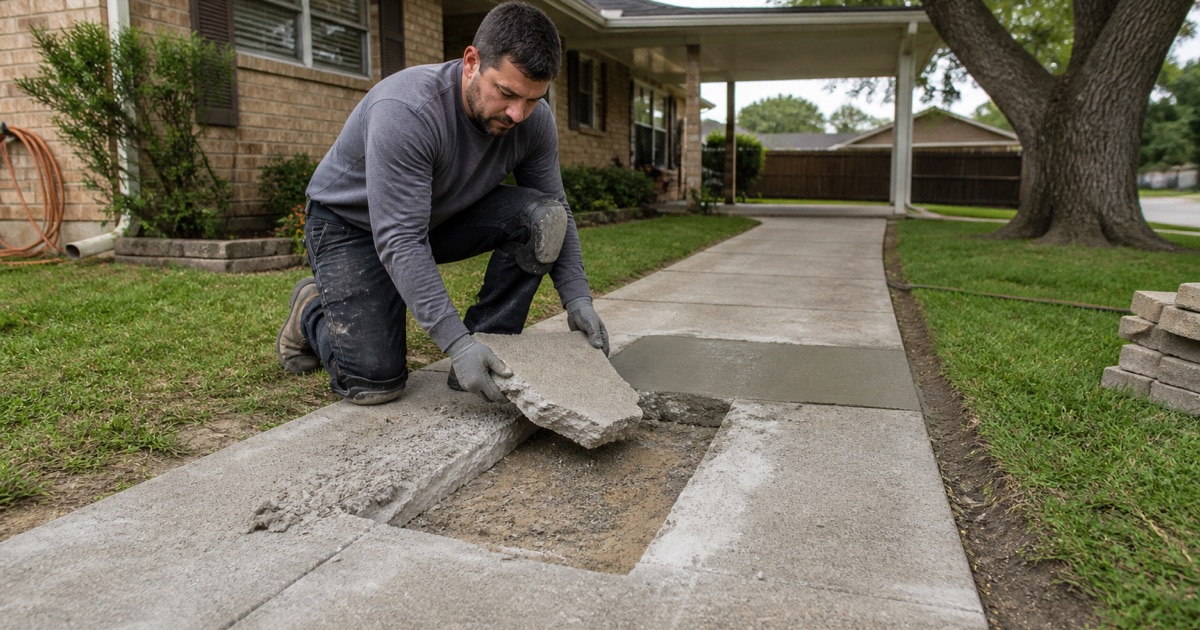
A driveway that has cracked into panels, dropped at the apron, or lifted where a tree root runs beneath it is the most common residential job we take. We assess whether the panels are still sound enough to raise or grind, and whether the base beneath has been washed out. Partial replacement of the failed panels is often cheaper and better than lifting the whole run.
Patio and Walkway Repair
Patios fail differently from driveways because they carry no vehicle load: what goes wrong is settlement at the edge furthest from the house, surface scaling, and joints that have opened and filled with weeds. We reset elevation where it has dropped, cut and reseal joints properly, and resurface where the wear is confined to the top layer rather than the section.
Garage Slabs, Steps and Aprons
The apron between the garage slab and the driveway is a joint between two things that move independently, so it is where cracks concentrate and where repairs are most often done badly. Steps and thickened edges fail the same way. We tie the repair into a proper expansion joint rather than grouting the gap and waiting for it to reopen.
Commercial Concrete Repair
Sidewalk Trip Hazards and Owner Liability
A vertical offset between adjacent panels on a commercial frontage is a liability before it is a maintenance item, and on required sidewalks in Killeen the abutting owner carries it. Concrete grinding takes an offset out in an afternoon where the panels either side are sound. Where the offset is being driven by an active void, grinding alone will not hold and we say so.
Parking Lot, Apron and Dumpster Pad Repair
Drive lanes, dock aprons, wheel stop bases and dumpster pads take turning loads a parking bay never sees, and they fail at the joints first. Since maintenance of a dumpster pad and its approach is expressly the property owner’s responsibility, that repair is not something the city will pick up. We rebuild the failed sections with dowel baskets at the construction joints.
Repairs That Have to Stay Accessible
Where a repair touches a public sidewalk or a curb ramp, it answers to the Public Right-of-Way Accessibility Guidelines, the Texas Accessibility Standards and chapter 25 of the city code at the same time. Killeen calls its curb ramps ambulatory ramps and expects the type, dimensions and finish to stay uniform. A patch that changes the running slope creates a bigger problem than it fixed.
Repair Methods and What Each One Is For
Route and Seal, Epoxy Injection and Carbon Fiber
Route and seal crack repair opens a crack to a clean profile and fills it with a flexible sealant, which suits a crack that is still moving seasonally. Epoxy crack injection bonds a structural separation back together where movement has stopped. Carbon fiber crack stitching holds a crack from widening further. The three are not interchangeable and picking wrong wastes the work.
Grinding, Resurfacing and Overlays
Concrete grinding removes offsets and high spots. A microtopping overlay or self leveling underlayment gives a worn but structurally sound slab a new wearing surface, and can be textured or colored. Both depend entirely on the slab underneath being sound, so we sound the concrete and check for voids before quoting any surface treatment.
Lifting Versus Replacing a Settled Slab
Polyurethane foam injection and a mudjacking slurry both raise a settled panel, and we quote both against straight replacement instead of steering you toward whichever equipment we happen to be running that week. Foam is lighter and cures in minutes; slurry is cheaper by volume. Where a panel is broken into more pieces than it can span, neither is the right answer.
Our Step-by-Step Concrete Repair Process
Site Assessment and Cause Diagnosis
We walk the slab, sound it for voids, check elevations across the panels and look at where roof and surface water actually goes. The cause gets identified before any method is proposed, because a repair chosen from a photograph of the crack is a guess dressed up as a quote.
Written Scope and Options Priced Side by Side
You get the repair options that genuinely apply, priced against each other and against full replacement, so the decision rests on real numbers rather than a single recommendation. Anything we rule out is named along with the reason it was ruled out, because knowing what you are not paying for matters as much as knowing what you are.
Permits Where the Work Needs Them
We pull what the work actually requires rather than leaving it to you to discover. Foundation slab repair has needed a permit here since Ordinance No. 22-004 took effect on January 25, 2022, and since January 1, 2026 it also requires engineered documents, which is a materially different scope from flatwork repair.
The Repair Itself
Drainage and base correction happen first, then the concrete work itself, with joints cut and detailed so the repaired area moves with the slab around it rather than fighting it. Where a void is involved it gets filled before anything on the surface is touched, since a patch bridging empty space has a short life by definition.
Cure, Seal and Walk the Job
We tell you when the area takes foot and vehicle traffic again, seal what should be sealed, and walk the finished work with you against the written scope before anything is invoiced. If something on that scope was not done, that is the moment to raise it rather than after the crew has left the street.
- 20+ Years in Central Texas
- Registered and Insured in Killeen
- Free Written Estimates