
Killeen Elite Concrete pours concrete slabs and pads in Killeen, TX and the surrounding cities including Fort Hood, Harker Heights, Nolanville, Copperas Cove and Belton, and the first question we ask is never how many square feet. It is what is going on top of it and how heavy that thing is, because a shed base, an RV pad and a metal building slab are three different structures that happen to share a name.
The second question is what the slab is sitting on. Depth to refusal inside these city limits runs from about nine inches on Eckrant soils to roughly thirty on San Saba, with Evant carrying a cemented caliche hardpan at around nineteen, and surface plasticity index in the high thirties across most of the mapped area. A pad poured onto whatever was there without a base is a pad that will move.
We size the section, the reinforcement and the base from those two answers and quote from there. That is slower than a rate per square foot and it is the reason our pads are still flat when the cheap ones have cracked into quarters.
Pads Sized to What They Carry
RV, Boat and Trailer Pads
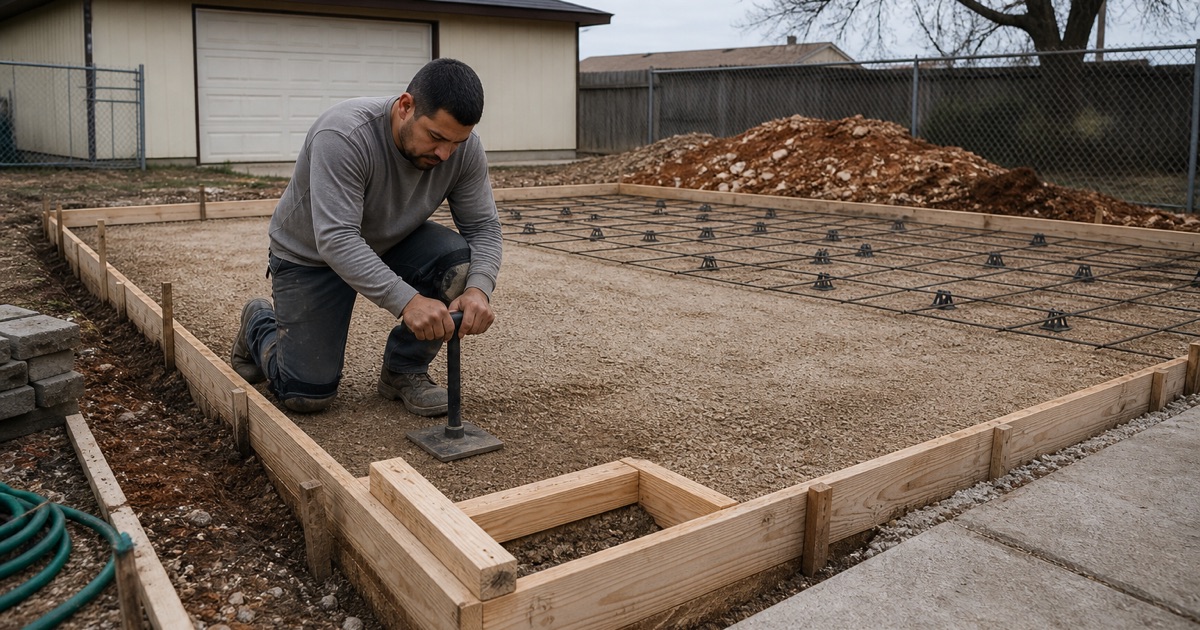
A fifth wheel or motorhome concentrates its weight on a small number of contact points and parks in the same spot for months, which is a very different loading from a car moving across a driveway. These pads get a heavier section, reinforcement placed on chairs where it resists tension, and a base built and compacted rather than graded. Landing gear points get particular attention.
Shop Floors and Metal Building Slabs
A metal building slab is doing two jobs: carrying the floor load and anchoring the structure. Anchor bolt layout, thickened edges or a turned-down perimeter, and the vapor retarder all have to be set before the pour rather than solved afterward. Since January 1, 2026 the retarder under a slab returns to 6 mil under IRC section R506.3.3, which is worth getting right the first time.
Hot Tub, Generator and Equipment Pads
A hot tub full of water and people is a concentrated dead load in a small footprint, and a standby generator adds vibration to that. These pads get sized for the filled weight rather than the shipping weight, with the base compacted properly underneath and conduit or plumbing sleeves cast in. Cutting a chase into a finished pad afterward is always the worse outcome.
Shed, Storage and Utility Pads
Shed and Workshop Bases
A shed base wants to be slightly larger than the building so water is not running off the roof directly onto the edge, and it wants a fall so nothing ponds against a timber sill. It is a modest pour and it still benefits from a compacted base and reinforcement, because a shed pad that cracks and tilts jams the doors within a couple of years.
AC Units, Meters and Small Service Pads
Small pads carry equipment that has to stay level to work properly and has to stay put through seasonal soil movement. We build them to the same standard as anything larger, scaled down: excavated, based, reinforced and given a fall. A condenser sitting on a pad that has tipped is a service call somebody else will charge you for.
Extending an Existing Slab
New concrete poured against old moves independently unless the joint says otherwise. A keyed construction joint or dowel baskets tie two slabs so they rise and fall together, while an expansion joint deliberately lets them separate where that is what you want. Getting this detail wrong is the most common reason an extension opens a visible gap in its first year.
What Goes Into the Section
Base, Compaction and Subgrade Treatment
Below the concrete, the base is what actually carries the load. Depending on the soil that means flexible base, a cement treated base, or a lime treated subgrade to reduce shrink swell potential under the pad. Compaction is done in lifts and measured rather than assumed, because a base that consolidates half an inch after the pour takes the slab down with it.
Reinforcement That Sits Where It Works
Welded wire reinforcement, fiber mesh reinforcement and rebar on chairs each answer a different requirement, and on a heavy pad more than one of them may be present. What matters as much as the choice is position: steel lying on the base does nothing, so it goes on slab bolsters and chairs in the part of the section that carries tension.
Joints, Thickness and Mix
Control joints go in at published spacing of roughly 24 to 36 times the slab thickness and are cut early with an early entry dry cut saw, so the crack that is coming lands in a line you chose. Thickness follows the load, and the mix is specified for the compressive strength the pad needs rather than whatever is cheapest that morning.
Getting It Poured Properly
Permits and What They Cost
Flatwork in Killeen is permitted by area at 11 cents per square foot with a 70 dollar minimum, plus a 10 dollar technology and application fee. We pull it before starting, because the city doubles the fee where work begins ahead of issue. A failed inspection costs 50 dollars and a partial one 35, which is a good argument for getting it right first time.
Placing Against the Discharge Clock
Once ambient temperature passes 90 degrees the truck has 45 minutes from batch to placement, so summer pours are scheduled against that clock rather than fitted around the rest of the day. Concrete worked past its window finishes badly at the surface, and on a shop floor or an equipment pad the surface is the part you live with.
Curing, Sealing and Handover
A slab left to dry fast in direct sun loses strength at the surface, so we cure deliberately with a curing compound instead of hoping for the best. Where the pad will see oil, chemicals or standing water, a penetrating sealer is worth doing. We tell you the date it takes full load rather than leaving you to guess at it.
- 20+ Years in Central Texas
- Registered and Insured in Killeen
- Free Written Estimates