
Killeen Elite Concrete works as a commercial concrete contractor in Killeen, TX and the surrounding cities including Fort Hood, Harker Heights, Nolanville, Copperas Cove and Belton, and the thing that separates commercial flatwork from residential here is not the size of the pour. It is the number of documents a single pour has to satisfy and the number of ways a project can be held up by one of them.
A commercial site brings together parking that has to meet the city’s all-weather surface definition, sidewalks in the public right of way answering to five separate accessibility standards at once, curb and gutter carrying its own permit and performance bond, dumpster pads with published minimum dimensions that the owner is responsible for maintaining, and possibly an accessibility review through the state. None of that is difficult, and all of it is expensive to discover late.
We hold a City of Killeen construction registration, which the city requires before a contractor may perform, contract to perform, or obtain a permit for permit-requiring work, and we carry the general liability coverage section 8-61 sets for our category. Twenty years here means we know which approvals a given commercial scope actually triggers before the schedule is built around it.
Parking, Drive Lanes and Site Circulation
Parking Surfaces and the All-Weather Rule
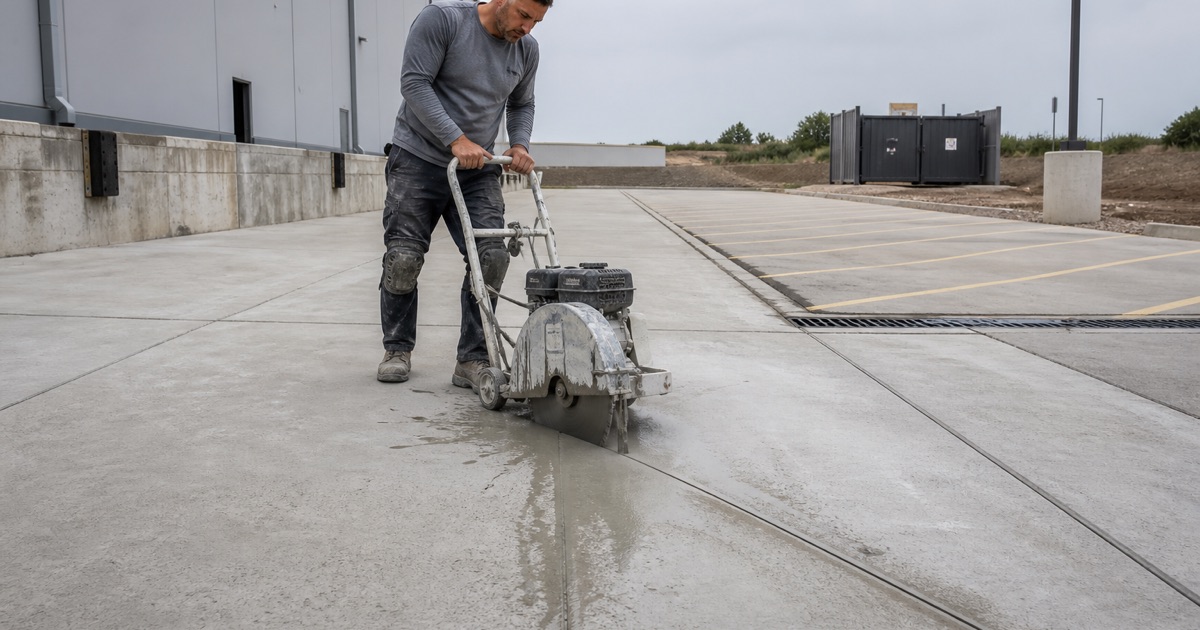
It is unlawful in Killeen to park a vehicle on anything but an all-weather surface, defined as Portland cement concrete, an impervious bituminous surface over a compacted base, or another surface the building official approves. Commercial and multifamily parking surfaces must additionally be capable of retaining paint or striping material, which rules out several cheaper options that otherwise look adequate.
Drive Lanes, Truck Pads and Turning Areas
Where trucks turn, brake and sit, the loading is concentrated and repetitive in a way a parking bay never sees. Those areas get a heavier section, dowel baskets at construction joints so adjacent panels share load rather than working independently, and a base built for the real traffic. Detailing joints where the turning actually happens is what stops an apron breaking up in its first year.
Curb, Gutter and the Right of Way
Curb, gutter and street curb work in the right of way runs under a separate permit filed with the city engineer with an estimated cost, and section 25-93 requires a performance bond equal to that full estimate or a cash deposit in its place. Section 25-91 withholds approval of the building work until non-conforming abutting curbs are brought to city standard, which makes this a schedule item as much as a cost one.
Accessibility and Code
Sidewalks Answering to Five Standards
One sidewalk pour in the public right of way has to satisfy the Public Right-of-Way Accessibility Guidelines, the Texas Accessibility Standards, ADA design requirements, chapter 25 of the city code and the Infrastructure Design and Development Standards Manual simultaneously. IDDSM Item 805 adds its own method requirements, including a wood-float finish to a rough texture and sidewalks scored into four-foot sections.
Ambulatory Ramps and Detectable Warnings
Killeen calls its curb ramps ambulatory ramps, and section 26-105 requires one at the end of each curb return at all street intersections in a subdivision, with the type, dimensions and surface finish uniform throughout. Running slope, cross slope, landings and detectable warning surfaces are where these are won or lost, so we shoot levels through every transition rather than judging them by eye.
State Accessibility Review
The city’s construction submittal guidance routes any construction project over 50,000 dollars to the Texas Department of Licensing and Regulation for accessibility review, and IDDSM Item 805 puts those approvals on the engineer of record. Below that threshold the standards still apply to the work itself. Knowing which side of the line a project sits on before the program is set avoids a genuinely expensive surprise.
Service, Waste and Loading Areas
Dumpster Pads and Approach Aprons
A single-container pad is a minimum of 14 feet wide and 12 feet 4 inches deep, and the approach apron a minimum of 14 feet wide and 15 feet deep, varying no more than 10 degrees above or below horizontal. Both must be concrete deemed to support the collection equipment, and pads must be screened on all sides to at least six feet.
Who Maintains Them, and Why It Matters
Maintenance of the site together with its approach is expressly the property owner’s responsibility, and the city disclaims responsibility for damage its collection vehicles cause to driveways, parking lots or other traveled surfaces. In practice that means a pad built light is a cost the owner absorbs repeatedly. Building it to carry a loaded collection truck the first time is the cheaper decision.
Loading Docks, Aprons and Wheel Stops
Dock aprons take the worst of a site’s loading: trailers landing, jacks bearing on a small footprint, and constant maneuvering. We build them thicker with load transfer at the joints, and we set wheel stop bases and bollard footings as part of the pour rather than drilling into finished concrete later. Cast-in is always stronger and always tidier than retrofitted.
Delivering Commercial Work
Permits, Fees and Inspections
Flatwork is permitted by area at 11 cents per square foot with a 70 dollar minimum, plus a 10 dollar technology and application fee, and the city doubles the fee where work starts before the permit issues. A failed inspection costs 50 dollars and a partial one 35. Right of way excavation deeper than 18 inches carries its own permit and a 2,000 dollar surety bond.
Phasing Around an Operating Site
Most commercial work happens on a site that has to keep trading, so pours get phased so access, parking and waste collection all keep functioning. That means more, smaller pours with properly detailed construction joints rather than one convenient placement. We agree the sequence with you before starting rather than negotiating it with your tenants afterward.
Scheduling Pours Against the Weather
Once the ambient temperature passes 90 degrees the truck has 45 minutes from batch to placement, so summer pours are scheduled against that clock and crewed to match. On a large commercial placement that changes start times and crew size rather than being absorbed quietly. Concrete worked past its window fails at the surface, which on a parking lot is the part that matters.
- 20+ Years in Central Texas
- Registered and Insured in Killeen
- Free Written Estimates