Killeen Elite Concrete does concrete resurfacing in Killeen, TX and the surrounding cities including Fort Hood, Harker Heights, Nolanville, Copperas Cove and Belton, and it is one of the few jobs in this trade where the honest answer is often that you do not need the expensive option. A slab that is worn, stained or dated on top but structurally sound underneath can be given a new surface for a fraction of what tearing it out and repouring costs.
Resurfacing means bonding a new wearing layer onto existing concrete. That layer can be a thin cementitious coat that simply renews a tired driveway, a self leveling underlayment that corrects an uneven interior floor, or a microtopping overlay that takes color and texture and turns a plain slab into a decorative one. What they all share is total dependence on the concrete underneath.
That dependence is why the assessment matters more than the product. A slab cracked because the base beneath it failed will crack an overlay in the same line, usually within the first season. We sound the slab, look at the joints, check for voids and look at where water goes before we offer any of it, and we will tell you when replacement is the right call instead.
Deciding Whether a Slab Can Be Resurfaced
What Makes a Slab a Good Candidate
The concrete needs to be sound through its section, reasonably level, and free of active movement. Surface problems are exactly what resurfacing is for: scaling, pitting, dusting, discoloration, old stains, tired broom finishes and dated exposed aggregate. If the only thing wrong with a slab is the top eighth of an inch, replacing the whole thing is buying a great deal you do not need.
What Rules It Out
Cracks with vertical offset between the two sides, panels rocking under load, sections that have settled, and surfaces that have delaminated in sheets all point at problems below the surface. An overlay bonded onto that hides the symptom and telegraphs the crack straight back through. We check for hollow areas by sounding the slab rather than judging it by eye.
Repair First, Then Resurface
Where the slab is mostly sound with localized problems, the sequence is repair, then resurface. That can mean lifting a settled panel back to elevation, routing and sealing a moving crack, epoxy injecting a structural one, or grinding a high spot flat. Doing those in the right order is what makes the finished surface uniform rather than a map of everything that was wrong.
The Systems We Use
Thin Cementitious Resurfacers
A polymer-modified resurfacer goes on thin and renews the wearing surface of a driveway, walk or patio, taking a broom or knockdown texture. It is the most economical option and it suits a slab whose only real problem is that it looks worn out. Correct surface preparation and profiling decide whether it bonds, which is why preparation is most of the labor.
Self Leveling Underlayment
Where an interior floor has gone out of level or a slab has minor undulation, a self leveling underlayment is poured and finds its own plane. It is the right answer before flooring goes down and where flatness matters more than appearance. It needs a contained, primed area and a sound substrate, and it is not a solution to a floor that is moving.
Microtopping Overlays and Decorative Finishes
A microtopping overlay gives a thin, hard surface that accepts integral color, dry shake color hardener, acid stain, texture skins and sawcut patterns. This is how a plain slab becomes decorative without demolition. Some systems are stampable, so a patio can take a pattern it never had, provided the slab beneath is genuinely sound and correctly prepared.
Surface Preparation and Bonding
Cleaning and Profiling
Nothing bonds to a dirty or sealed surface. Existing sealers, curing compounds, paint, oil and laitance all have to come off, and the surface is then mechanically profiled by grinding or shot blasting so the new layer has something to key into. This step is unglamorous and it is the single biggest predictor of whether a resurfacing job lasts.
Handling the Joints
Existing control and expansion joints have to be honored through the new surface rather than covered over. A joint that is filled and skimmed will reappear as a crack in the overlay, because the slab beneath still moves there. We carry every working joint through the new layer and re-cut it, which also keeps the finished appearance deliberate.
Curing, Sealing and Return to Service
Overlays are thin and lose water fast, so curing them properly matters more than it does on a full-depth pour, particularly in summer. Once cured, sealing protects the color and slows staining. A penetrating sealer suits exterior slabs in this climate, with a grit additive where the surface will be walked on wet.
Where Resurfacing Earns Its Keep
Driveways, Patios and Walks
The commonest job is a driveway or patio that is structurally fine and looks fifteen years old, because it is. Resurfacing brings back a uniform surface and can add color or texture at the same time, at a cost well below replacement. It also avoids the demolition, the disposal and the week the area is out of use.
Garage, Shop and Interior Floors
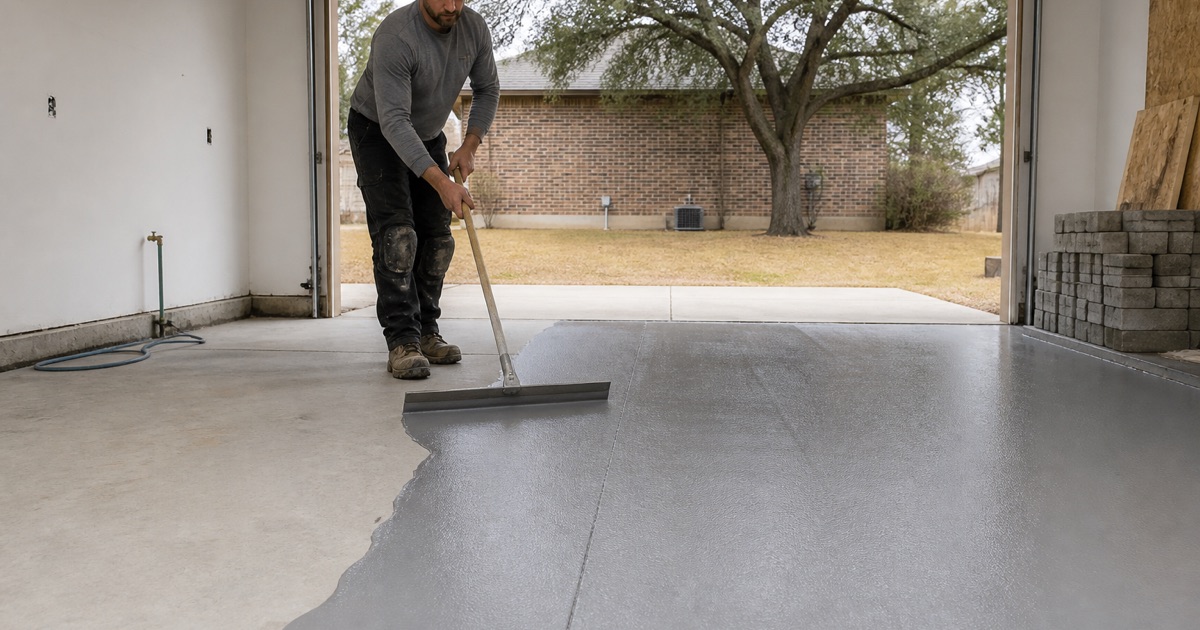
Interior slabs benefit from resurfacing for a different reason: flatness and cleanability. A garage or shop floor that has spalled or been stained by years of use can be leveled and given a hard, sealable surface. That is a considerable improvement in a space where the alternative is living with it or breaking out the slab.
Commercial and Rental Property
On rental property around Fort Hood and on commercial frontages, resurfacing gets an area back into service quickly and presentably without closing it for a week. Where the surface is a walkway the public uses, we keep the finished elevation and texture consistent with the accessibility requirements the original pour had to meet.
- 20+ Years in Central Texas
- Registered and Insured in Killeen
- Free Written Estimates